In the English
language, words can be considered as the smallest elements that have
distinctive meanings. Based on their use and functions, words are categorized
into several types or parts of speech. This article will offer definitions and
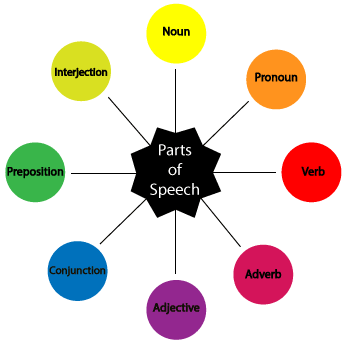
examples for the 8 major parts of speech in English grammar: noun, pronoun, verb, adverb, adjective,conjunction, preposition, and interjection.
This part of a speech refers to words
that are used to name persons, things, animals, places, ideas, or events. Nouns
are the simplest among the 8 parts of speech, which is why they are the first
ones taught to students in primary school.
Examples:
§ Tom Hanks is very versatile.
§ The italicized noun refers to a name of a person.
§ Dogs can be extremely cute.
§ In this example, the italicized word is considered a noun because it names
an animal.
§ It is my birthday.
§ The word “birthday” is a noun which refers to an event.
There are different types of nouns
namely:
§ Proper– proper nouns always start with a capital letter and refers to specific
names of persons, places, or things.
§ Examples: Volkswagen Beetle, Shakey’s Pizza, Game of Thrones
§ Common– common nouns are the opposite of proper nouns. These are just generic
names of persons, things, or places.
§ Examples: car, pizza parlor, TV series
§ Concrete– this kind refers to nouns which you can perceive through your five
senses.
§ Examples: folder, sand, board
§ Abstract- unlike concrete nouns,
abstract nouns are those which you can’t perceive through your five senses.
§ Examples: happiness, grudge, bravery
§ Count– it refers to anything that is countable, and has a singular and plural
form.
§ Examples: kitten, video, ball
§ Mass– this is the opposite of count nouns. Mass nouns are also called
non-countable nouns, and they need to have “counters” to quantify them.
§ Examples of Counters: kilo, cup, meter
§ Examples of Mass Nouns: rice, flour, garter
§ Collective– refers to a group of persons, animals, or things.
§ Example: faculty (group of teachers), class (group of students), pride
(group of lions)
A pronoun is a part of
a speech which functions as a replacement for a noun. Some examples of pronouns
are: I, it, he, she, mine,
his, hers, we, they, theirs, and ours.
Sample Sentences:
§ Janice is a very stubborn child. She just stared at me and when I told her to stop.
§ The largest slice is mine.
§ We are number one.
The italicized words in the sentences
above are the pronouns in the sentence.
This part of a speech is used to
describe a noun or a pronoun. Adjectives can specify the quality, the size, and
the number of nouns or pronouns.
Sample Sentences:
§ The carvings are intricate.
§ The italicized word describes the appearance of the noun “carvings.”
§ I have two hamsters.
§ The italicized word “two,” is an adjective which describes the number of
the noun “hamsters.”
§ Wow! That doughnut is huge!
§ The italicized word is an adjective which describes the size of the noun
“doughnut.”
This is the most important part of a
speech, for without a verb, a sentence would not exist. Simply put, this is a
word that shows an action (physical or mental) or state of being of the subject
in a sentence.
Examples of “State of
Being Verbs” : am, is, was, are, and were
Sample Sentences:
§ As usual, the Stormtroopers missed their shot.
§ The italicized word expresses the action of the subject “Stormtroopers.”
§ They are always prepared in emergencies.
§ The verb “are” refers to the state of being of the pronoun “they,” which is
the subject in the sentence.
Just like adjectives, adverbs are also
used to describe words, but the difference is that adverbs describe adjectives,
verbs, or another adverb.
The different types of adverbs are:
§ Adverb of Manner– this refers to how something happens
or how an action is done.
§ Example: Annie danced gracefully.
§ The word “gracefully” tells how Annie danced.
§ Adverb of Time- this states “when” something happens or “when” it
is done.
§ Example: She came yesterday.
§ The italicized word tells when she “came.”
§ Adverb of Place– this tells something about “where” something happens
or ”where” something is done.
§ Example: Of course, I looked everywhere!
§ The adverb “everywhere” tells where I “looked.”
§ Adverb of Degree– this states the intensity or the
degree to which a specific thing happens or is done.
§ Example: The child is very talented.
§ The italicized adverb answers the question, “To what degree is the child
talented?”
This part of a speech basically refers
to words that specify location or a location in time.
Examples of
Prepositions: above, below,
throughout, outside, before, near, and since
Sample Sentences:
§ Micah is hiding under the bed.
§ The italicized preposition introduces the prepositional phrase “under the
bed,” and tells where Micah is hiding.
§ During the game, the audience
never stopped cheering for their team.
§ The italicized preposition introduces the prepositional phrase “during the
game,” and tells when the audience cheered.
The conjunction is a part of a speech
which joins words, phrases, or clauses together.
Examples of
Conjunctions: and, yet, but, for,
nor, or, and so
Sample Sentences:
§ This cup of tea is delicious and very soothing.
§ Kiyoko has to start all over again because she didn’t follow the professor’s
instructions.
§ Homer always wanted to join the play, but he didn’t have the
guts to audition.
The italicized words in the sentences
above are some examples of conjunctions.
This part of a speech refers to words
which express emotions. Since interjections are commonly used to convey strong
emotions, they are usually followed by an exclamation point.
Sample Sentences:
§ Ouch! That must have hurt.
§ Hurray, we won!
§ Hey! I said enough!
The bold words attached to the main
sentences above are some examples of interjections.
Final Thoughts
You must familiarize yourself with the
different parts of speech discussed in this article because they are among the
most fundamental concepts that you will encounter throughout your study of
grammar. An in-depth knowledge of this topic will not only make you a better
writer, but an effective communicator as well.